
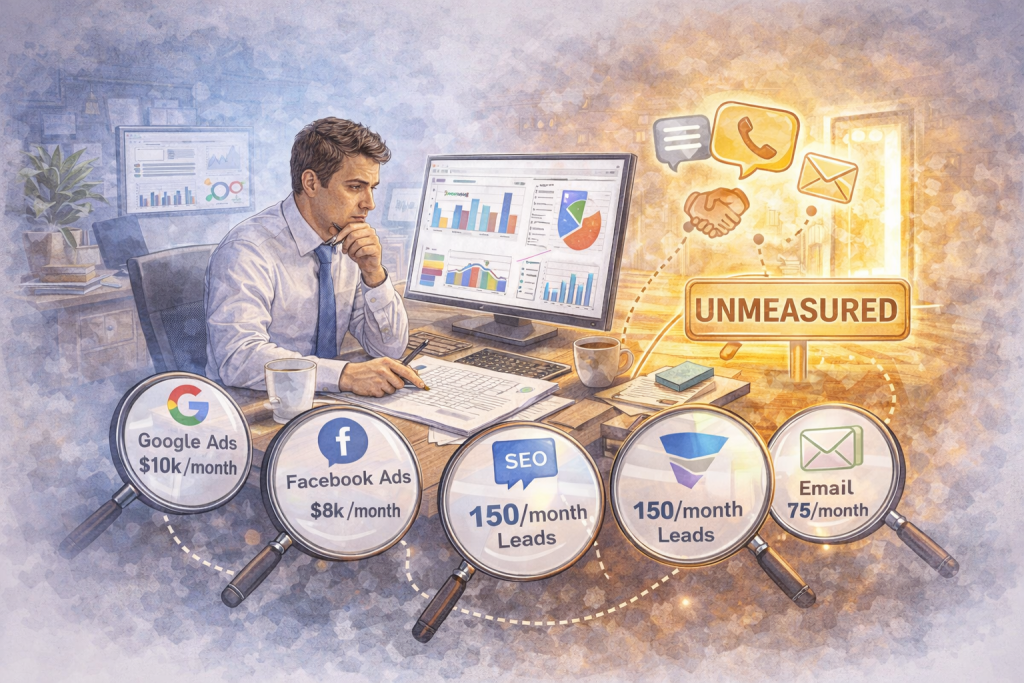
Ask a managing partner at an immigration firm where their best cases come from, and the answer is almost always the same: referrals.
Past clients who told their friends. Community members who trust the firm. Other attorneys who send overflow work. Family networks where one successful case turns into three more.
Now ask that same managing partner: which referral sources produced the most retained cases last year? Which community relationships generate the highest-value matters? Which of your past clients have referred more than once?
Silence. Or a guess. Or “I would need to check.”
The channel every immigration firm knows is their best is also the channel almost no firm measures. Referrals, Google Business Profile, and organic website traffic produce 50–70% of retained cases at most immigration firms — and nearly all of them are invisible in any marketing report.
The three invisible channels
Immigration firms spend thousands of dollars per month on paid channels that produce detailed reports. Google Ads shows every click, every impression, every dollar spent. Directories send monthly performance summaries. Even SEO agencies can show ranking changes and traffic trends.
But the channels that produce the most cases at the lowest cost? They produce no reports at all. Because nobody built the system to track them.
Invisible channel 1: Referrals
At most immigration firms, referrals account for 50–70% of all retained cases. These come from past clients, community leaders, family networks, ethnic media, WhatsApp groups, church communities, attorney-to-attorney relationships, and dozens of other trust-based connections.
The typical tracking system for referrals at an immigration firm is: nothing. Or a sticky note. Or a CRM field labeled “Referral” that gets filled in about half the time with no detail about who actually referred the person.
The result is that the firm’s most productive growth channel exists entirely in anecdote. The managing partner has a general sense that “Mrs. Garcia sends us a lot of clients” but cannot say whether Mrs. Garcia sent 3 cases or 15 last year, what those cases were worth, or whether the referral relationship has been growing or declining.
This matters because referral relationships are not random. They are cultivatable. A firm that knows which 10 referral sources produce 80% of its referral cases can invest time, attention, and gratitude in those relationships deliberately. A firm that treats all referrals as undifferentiated luck cannot. It just hopes they keep coming.
Invisible channel 2: Google Business Profile
The Google Business Profile (formerly Google My Business) is one of the highest-value free marketing channels for any local law firm. When someone searches “immigration lawyer near me,” the firm’s GBP listing appears in the map pack — often above the paid ads and organic results.
GBP generates phone calls, website clicks, direction requests, and direct messages. Google provides some data on these interactions, but most firms never look at it. And critically, GBP calls are almost never tracked separately from the firm’s main phone line. A client who calls from the GBP listing looks identical to a client who called from the website, from a Google Ad, or from a referral.
The fix is simple: assign a call tracking number specifically to the GBP listing. This takes 10 minutes to set up in any call tracking tool. Once it is in place, the firm can see: the GBP listing produced 22 calls last month. Of those, 8 became consults. Of those, 4 retained. Cost: zero — the listing is free. The only investment is maintaining reviews and keeping the profile updated.
Most immigration firms are sitting on a channel that produces free retained cases and have never measured it. They cannot tell you whether the GBP listing produces 5 cases a month or zero. That is like having a store with a second entrance and never counting how many customers walk through it.
Invisible channel 3: Organic and direct website traffic
Organic traffic — people who find the firm through non-paid Google search results — and direct traffic — people who type the firm’s URL directly or click a link from a non-trackable source — together represent a significant source of leads at most immigration firms.
Google Analytics shows how many people visit the site and from which channels. But that data lives in a dashboard nobody at the firm checks, and it stops at the website. It does not follow the visitor into the intake process. A prospect who finds the firm through an organic search, visits the website, and calls the main number looks exactly like every other phone call unless call tracking is in place.
The invisible cost of not tracking organic traffic is that the firm cannot evaluate its website’s actual performance. A firm might spend $15,000 redesigning its website and have no way to measure whether the new site produces more retained cases than the old one. It might invest in blog content and have no way to know whether that content drives consults. Every website decision becomes aesthetic instead of economic.
Why unmeasured channels are the most expensive problem you do not see
The irony is that most immigration firms spend their marketing budgets on paid channels that they measure (poorly) while ignoring free and low-cost channels that they do not measure at all.
Consider a firm that spends $10,000/month on Google Ads and produces 4 retained cases from that spend. Cost per retained case from Google Ads: $2,500.
Meanwhile, the same firm gets 6 retained cases per month from referrals at essentially zero cost, 3 from the Google Business Profile at zero cost, and 2 from organic search at zero cost. Those 11 free cases produce more revenue than the 4 paid cases — and the firm has no data on any of them.
When the managing partner evaluates whether marketing is working, they look at the Google Ads report. They do not see the referrals, the GBP cases, or the organic leads because those channels have no report. The conversation becomes entirely about paid acquisition when the majority of cases come from channels nobody is measuring.
The most dangerous outcome is not that the firm underspends on paid. It is that the firm overinvests in paid because it is the only channel with a report, while neglecting the invisible channels that are actually doing most of the heavy lifting.
A firm that knows referrals produce 6 cases/month at zero cost might invest 5 hours per week in referral relationship maintenance — calls, lunches, thank-you notes, community events. That investment produces more cases per dollar than any Google Ad campaign. But without the data, the firm defaults to the channel that sends a monthly PDF.
How to start measuring your invisible channels
You do not need a data team or expensive analytics tools. You need three changes that can be implemented in a single week.
Change 1: Ask the question
Train every person who answers a phone call or processes a form fill to ask: “How did you hear about us?”
This is the single highest-value data collection practice in any immigration firm’s intake process. It takes 5 seconds. It costs nothing. And it transforms referrals from invisible to measurable.
The key: Do not accept “referral” as the answer. Ask the follow-up: “Who referred you?” or “Where specifically did you hear about us?” The difference between “referral” and “Mrs. Garcia from my church” is the difference between useless data and actionable intelligence. Log the referral source name in the CRM every time.
For non-referral answers: If the caller says “I found you on Google,” the intake coordinator should ask: “Did you click on an ad or find us in the regular search results?” Most callers can tell the difference. This helps distinguish paid from organic even when call tracking is imperfect.
Change 2: Set up a dedicated tracking number for GBP
Assign a unique call tracking number to your Google Business Profile listing. CallRail, CallTrackingMetrics, or any call tracking tool can do this in 10 minutes. Replace the phone number displayed on your GBP listing with the tracking number. Every call that comes through that number is now tagged as a GBP lead.
Do the same for the website: use a separate tracking number for website visitors so calls from the website are distinguished from calls from the GBP listing, direct dials, and other sources.
The math on this: If your GBP listing produces even 3 retained cases per month at an average fee of $5,000, that is $15,000 in monthly revenue from a free channel. Knowing that number changes how you invest in reviews, profile optimization, and GBP posts. Not knowing it means you are flying blind on a channel worth $180,000/year.
Change 3: Tag every lead from day one
Create a standardized source dropdown in your CRM. Every lead gets tagged with a source before any other work is done. The list should include: Google Ads, Local Services Ads, Google organic, Google Business Profile, referral (with a referral source name field), directory, social media, walk-in, attorney referral, community/ethnic media, and other.
This is the same recommendation from the CRM cleanup framework. The reason it keeps coming up is that source tagging is the foundation of every measurement improvement. Without it, nothing else works. With it, the firm can answer every important question about where cases come from.
Within 60 to 90 days of consistent tagging, the firm will have enough data to produce its first complete source-to-retainer breakdown. For the first time, the managing partner will see the full picture: paid channels, referral channels, free channels, and the relative contribution of each one.
What the data reveals (and why it changes everything)
Firms that start measuring their invisible channels consistently for the first time almost always discover three things:
1. Referrals produce more cases than they thought. The anecdotal sense that “referrals are important” becomes a concrete number. Often, referrals account for 50–70% of retained cases — far more than most managing partners estimated. This reframes the growth conversation: instead of “how do we get more Google Ads leads,” it becomes “how do we systematically grow and protect our referral base.”
2. A small number of referral sources produce most of the referral cases. Referrals are not evenly distributed. Often, 5–10 people or relationships are responsible for 60–80% of all referral cases. One community leader, one former client who tells everyone, one attorney who sends overflow work. These relationships are the most valuable assets in the firm’s growth system — and until they are measured, they are taken for granted.
3. The Google Business Profile is a real channel. Most firms discover that their GBP listing produces meaningful leads and retained cases that were previously invisible. This changes how the firm thinks about reviews (the most important factor in GBP visibility), profile completeness, and local SEO. A firm that tracks GBP as a channel can see the direct impact of earning 10 new reviews in a month.
Once you can see where your cases actually come from, every growth decision changes. You stop over-indexing on the channel with the loudest report and start investing in the channels with the best results — even if those channels never sent you a PDF.
One question that changes everything
Every framework in this article — the referral tracking, the GBP attribution, the source tagging — starts with one question asked at the beginning of every intake call:
“How did you hear about us?”
Five words. Five seconds. Asked of every caller, every form fill, every walk-in, every prospective client who contacts the firm for any reason.
The answer gets logged in the CRM with a specific source tag. If it is a referral, the referral source name gets recorded. If it is Google, the coordinator clarifies whether it was an ad or organic. If the caller is not sure, “unknown” is acceptable — but the question still gets asked.
Within 90 days of asking this question consistently, the firm will know more about where its cases come from than it has ever known. It will see which channels produce retained cases, which referral sources are most valuable, and which investments are actually driving growth.
That knowledge does not require an agency. It does not require new software. It does not require a data analyst. It requires one question, one dropdown in the CRM, and the discipline to do it every time.
Your best marketing channel is probably one you are not measuring. Start measuring it, and everything about how you invest in growth gets sharper.
Lexfull helps immigration law firms fix intake, visibility, and growth execution.
If your firm does not know which channels produce its retained cases, book a Growth Diagnostic and we will build the visibility framework that makes it clear.