
At some point, every managing partner at a growing immigration firm arrives at the same realization: the firm needs marketing leadership, not just marketing activity. The agency is running campaigns. The intake team is answering phones. The CRM exists. But nobody is connecting the pieces, measuring what matters, or making decisions based on data instead of gut feeling.
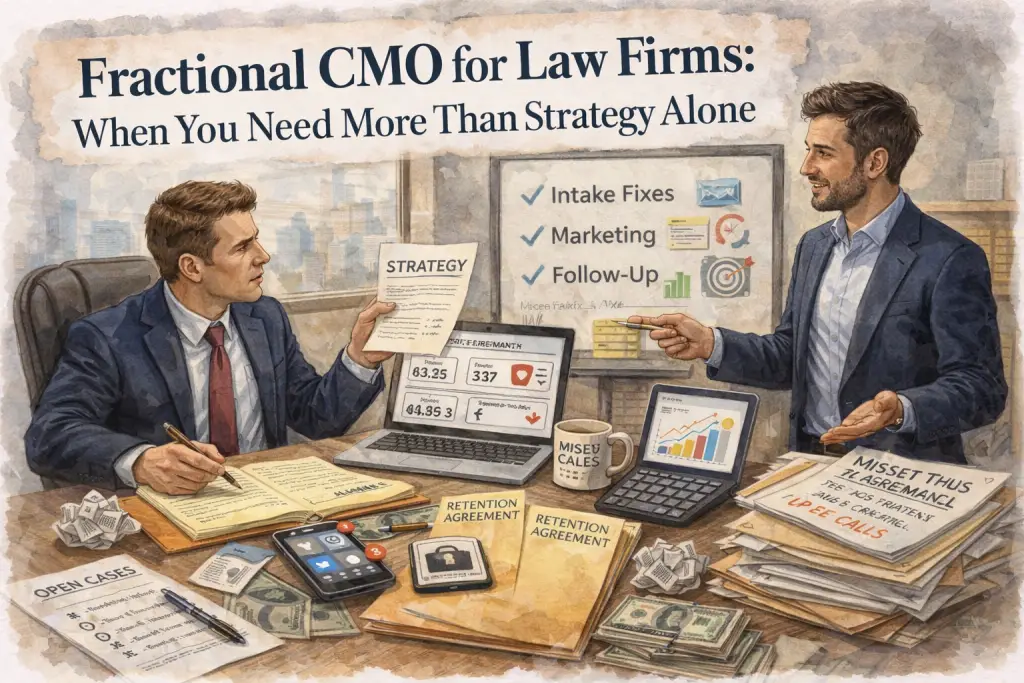
The natural search that follows is “fractional CMO for law firms” — the idea that you can hire executive-level marketing leadership part-time, at a fraction of the cost of a full-time hire, to bring order to the chaos.
It is a reasonable instinct. But for most immigration firms with 2–12 attorneys, a traditional fractional CMO is not quite the right fit. Not because the concept is wrong, but because the scope is too narrow for what the firm actually needs.
This article explains what a fractional CMO for law firms actually does, how it compares to an agency, a consultant, and a growth operator, and how to decide which model fits your firm’s stage, complexity, and goals.
Why immigration firms start searching for a fractional CMO
The search usually starts after one or more of these moments:
The agency cycle. The firm has been through one, two, or three agencies. Each one generated activity — campaigns, reports, traffic. None of them connected that activity to retained cases. The managing partner is tired of evaluating vendors they cannot hold accountable and wants someone on their side of the table.
The time trap. The managing partner is spending 10–15 hours per week on growth-related tasks that are not practicing law — reviewing reports, managing vendors, checking dashboards, chasing intake issues, making marketing decisions between hearings. They need someone to take ownership of the growth function so the partner can go back to being an attorney.
The visibility gap. The firm spends $8,000–$15,000/month on marketing and cannot answer one question: what did we get for it? There is no dashboard connecting spend to retained cases. No source attribution. No pipeline tracking. The partner knows this is broken but does not have the expertise or time to fix it.
The hiring hesitation. A full-time marketing director costs $120,000–$200,000+ in salary and benefits. The firm cannot justify that expense, is not sure what the role should do, and does not want to manage another employee. A fractional or part-time CMO for law firms feels like a safer, more flexible option.
All of these are legitimate reasons. The question is not whether the firm needs marketing leadership. It almost certainly does. The question is what kind of leadership — and what scope of work — actually solves the problem.
Agency vs. consultant vs. fractional CMO vs. growth operator: what is the difference?
Managing partners often use these terms interchangeably. They are not the same. Each model offers a different scope of ownership, a different level of involvement, and a different set of outcomes. Understanding the differences is critical before signing anything.
The marketing agency
What they do: Execute marketing tactics. Run Google Ads, SEO campaigns, social media, content production, web design. They are hired to do specific channel work and report on it monthly.
What they own: The top of the funnel. Traffic, clicks, impressions, leads. Their scope ends when the lead arrives.
What they do not own: Intake. Follow-up. Consultation conversion. CRM configuration. Vendor coordination. Revenue visibility. The connection between marketing spend and retained cases.
Best fit: Firms that already have internal marketing leadership and need execution capacity in a specific channel.
The gap: Most immigration firms under 20 attorneys do not have internal marketing leadership. They hire the agency and expect it to be the leadership. The agency does channel work. The firm expects business outcomes. Nobody bridges the gap.
The marketing consultant
What they do: Assess the firm’s marketing situation, identify problems, and deliver a strategic plan. Sometimes a one-time engagement, sometimes a short-term project.
What they own: The diagnosis and the strategy. They tell you what to fix.
What they do not own: Implementation. They hand over a plan and the firm is responsible for executing it — or hiring someone to execute it.
Best fit: Firms that have internal capacity to execute but need strategic direction.
The gap: Most immigration firms under 20 attorneys do not lack a plan. They lack the capacity to implement one. A consultant who delivers a 30-page strategy document to a firm with no operations coordinator, no CRM hygiene, and no one to manage vendors is handing a blueprint to someone without a construction crew.
The fractional CMO
What they do: Provide part-time executive-level marketing leadership. They develop strategy, hire and manage agencies, oversee campaigns, align marketing with business goals, and report to the managing partner on performance.
What they own: Marketing strategy and vendor management. They sit between the firm and its agencies and ensure the marketing function is moving in the right direction.
What they do not typically own: Intake operations. CRM pipeline configuration. Follow-up sequences. Speed-to-lead monitoring. Consultation confirmation workflows. No-show recovery. The weekly operating cadence that connects marketing to retained cases.
Best fit: Firms that have a functioning intake system and need someone to lead the marketing strategy and vendor stack.
The gap: For most immigration firms, marketing strategy is only half the problem. The other half is what happens after the lead arrives — the intake process, the follow-up speed, the consult conversion, the pipeline visibility. A traditional fractional CMO law firm engagement focuses on the marketing side but does not typically reach into operations. The partner is still left owning the middle.
The growth operator (fractional growth partner)
What they do: Own the full growth system — from marketing governance through intake operations, conversion visibility, vendor accountability, and the weekly cadence that holds it all together. They do not just develop strategy or manage agencies. They build the operational infrastructure that connects marketing spend to retained cases and run the cadence that keeps it accountable.
What they own: The pipeline. The dashboard. The weekly review. The intake SLAs. The follow-up sequences. The vendor KPIs. The source-to-retainer attribution. The connection between what the firm spends and what the firm gets.
What they do not own: Legal strategy. Case management. HR. Full internal staffing. They are not a replacement for an entire department — they are the operator who makes the growth function run without the managing partner in the middle of every decision.
Best fit: Immigration firms with 2–12 attorneys that need one accountable person across marketing, intake, visibility, and execution — not just a strategist and not just a vendor.
The managing partner searching for a fractional CMO for law firms is usually describing a growth operator problem, not a CMO problem. They do not need someone to write a marketing strategy. They need someone to build and run the system that makes marketing, intake, and conversion work together.
What scope, ownership, and weekly cadence should look like
The practical difference between these models becomes clear when you compare what they actually do week to week inside a small or midsize law firm.
What an agency does each week
Manages campaigns. Adjusts bids and budgets. Writes ad copy. Publishes content. Sends a monthly report. Joins a monthly call. Their week revolves around channel activity.
What a consultant does each week
Usually nothing on an ongoing basis. They delivered a strategy document. Maybe they check in quarterly. The firm is on its own for execution.
What a fractional CMO does each week
Reviews the agency’s performance. Meets with the managing partner to discuss marketing direction. Evaluates campaign strategies. Makes recommendations on budget allocation. May interview or manage agency hires. Their week revolves around marketing oversight and strategic direction.
What a growth operator does each week
Checks the intake dashboard. Reviews speed-to-lead numbers. Identifies missed calls and follow-up failures. Catches no-shows and confirms recovery workflows are running. Evaluates campaign performance against retained-case data. Coordinates with the agency using the firm’s scorecard. Runs the 15-minute Monday growth review. Documents what broke, what was fixed, and what the priorities are for the coming week. Sends the managing partner a short summary with 2–3 decision points.
Their week revolves around the full pipeline — not just marketing, not just intake, but the connection between them.
The question for any managing partner evaluating these options is: which of these weekly rhythms would actually solve the problem I have today? If the answer is “I need someone watching the full pipeline, not just the campaigns,” the search for an outsourced CMO for law firms may actually be a search for a growth operator.
How to know which model your firm needs
Here are five diagnostic questions. Answer them and the right model becomes obvious.
1. Does your firm have a functioning intake system with defined SLAs?
If yes — meaning leads are answered within 5 minutes, form fills get auto-responses, consultations have confirmation sequences, and no-shows get recovery texts — the intake side is covered. You may genuinely need a fractional CMO to focus on the marketing strategy and vendor management.
If no — and most firms under 20 attorneys answer no — hiring a CMO to manage the marketing without fixing intake is like hiring a head chef for a restaurant with no kitchen. The campaigns will generate leads that leak through a broken system.
2. Can anyone inside the firm calculate cost per retained case by channel?
If yes — call tracking exists, the CRM has pipeline stages, source tagging is consistent, and a dashboard connects spend to retained cases — the measurement infrastructure is in place. A fractional CMO can work with this data to optimize strategy.
If no — and the firm evaluates marketing with gut feeling and the billing system — the measurement infrastructure needs to be built before anyone can lead marketing effectively. A growth operator builds this infrastructure. A traditional CMO typically assumes it already exists.
3. Is the managing partner spending more than 3–4 hours per week on growth tasks?
If the partner is checking dashboards at night, managing vendors between hearings, chasing intake problems, and building spreadsheets on weekends — the firm does not just need strategy. It needs someone to take operational ownership of growth so the partner can practice law.
A fractional CMO reduces the partner’s involvement in marketing decisions. A growth operator reduces the partner’s involvement in everything between marketing spend and retained cases.
4. Does the firm have someone to manage vendors day to day?
If the firm has an office manager or marketing coordinator who handles vendor communication, approves content, and tracks deliverables, a fractional CMO can direct that person strategically.
If the managing partner is the one answering every agency email, approving every ad copy revision, and deciding every budget question — the firm needs an operator who handles vendor accountability as part of the weekly cadence, not just a strategist who creates a plan for someone else to execute.
5. What broke the last time the firm worked with an agency?
If the issue was genuinely bad campaign work — wrong keywords, poor targeting, wasted spend on irrelevant clicks — the firm may need better marketing strategy, which a fractional CMO provides.
If the issue was that nobody could tell whether the agency was working because there was no tracking, no pipeline visibility, no follow-up system, and no dashboard connecting spend to cases — the problem was not the agency’s tactics. It was the absence of the operating system that makes any agency evaluable. That is a growth operator problem.
Most immigration firms under 12 attorneys who search for a part-time CMO for law firms answer “no” to questions 1, 2, and 4. That profile points toward a growth operator, not a traditional CMO. The firm needs someone who builds and runs the system, not someone who manages a system that does not exist yet.
What to look for when hiring a fractional CMO or growth partner for a law firm
Regardless of which model you choose, here are the non-negotiables for any executive-level growth hire at an immigration firm:
They must understand the full pipeline, not just campaigns
A lead that clicks on an ad and calls the firm is not a success unless someone answers, follows up, books a consultation, confirms it, holds it, and retains the case. Anyone who leads growth at your firm must understand and take ownership of as much of that pipeline as possible — not just the top.
They must build measurement infrastructure, not assume it exists
If the first thing your new hire does is ask for a marketing strategy meeting, that may be premature. If the first thing they do is audit call tracking, check the CRM pipeline, review intake speed, and build a dashboard — they understand how law firms actually operate. The infrastructure comes before the strategy.
They must own a weekly cadence
Strategy without rhythm is a document that gets filed. The person leading growth should run a weekly operating cadence — reviewing KPIs, catching intake failures, managing vendor accountability, setting priorities, and reporting to the managing partner. If they only show up for a monthly strategy call, they are a consultant with a fancier title.
They must reduce managing partner involvement, not increase it
The entire point of outsourcing growth leadership is to give the partner time back. If the new hire creates more meetings, more approvals, more questions, and more complexity, they are adding to the problem. The managing partner’s involvement should drop from 10+ hours per week to one 15-minute weekly review within the first 60–90 days.
They must know immigration
Immigration clients behave differently than PI, family law, or criminal defense clients. They search in multiple languages. They rely on community trust. They call after hours. They make decisions with family. They may distrust the legal system. A growth leader who does not understand these dynamics will build campaigns and processes that work for generic legal but miss half the picture for immigration.
5 mistakes law firms make when hiring fractional marketing leadership
Mistake 1: Hiring strategy when you need infrastructure
If the firm has no call tracking, no CRM pipeline, and no dashboard, hiring a strategist is premature. Build the measurement system first. Then hire someone to optimize based on what the data shows.
Mistake 2: Assuming a CMO title means full-pipeline ownership
Most fractional CMOs — especially generalists who serve multiple industries — focus on marketing strategy and vendor oversight. They do not typically configure CRMs, build follow-up sequences, monitor intake speed, or run weekly operating cadences. If the firm needs full-pipeline ownership, confirm the scope explicitly before signing.
Mistake 3: Hiring someone who has never worked with law firms
Legal marketing has compliance constraints (ABA ethics rules, state bar advertising rules), platform restrictions (Google’s legal advertising policies), and client dynamics that generalist marketers do not know. A fractional CMO from SaaS or e-commerce will spend the first 3 months learning things that a legal-focused operator already knows. That learning curve costs the firm time and money.
Mistake 4: Keeping the agency and the CMO in separate lanes
If the fractional CMO manages strategy and the agency manages execution but neither owns the pipeline between them, the same gap that existed before the CMO was hired still exists. The person leading growth must have authority over vendor accountability, including the ability to demand real KPIs, change reporting formats, and escalate underperformance.
Mistake 5: Not defining success before the engagement starts
What does success look like in 90 days? Is it a functioning dashboard? A specific cost per retained case? A show-rate improvement? A reduction in managing partner growth hours? If these outcomes are not defined upfront, the engagement will drift into vague “marketing improvement” territory and the firm will be unable to evaluate whether the hire was worth it.
The metrics your fractional growth leader should be measured against
Whether you call them a fractional CMO, a growth operator, or a fractional growth partner, the person leading growth at your firm should be evaluated against these metrics — not against marketing activity.
Cost per retained case by channel. This is the north star. If this number is improving over 90 days, the engagement is working.
Lead-to-consult conversion rate. Measures whether the intake system is tightening. Should improve from baseline within 60 days.
Consultation show rate. Measures whether confirmation and recovery workflows are running. Should reach 80%+ within 60 days.
Response-time SLA compliance. Measures whether leads are being contacted fast enough. Should reach 80%+ within 30 days.
Managing partner growth hours per week. Measures time back. Should drop from 10–15 hours to under 2 hours within 90 days.
Dashboard accuracy and trust. Measures whether the managing partner can open one screen and see the full pipeline. Should be live and trusted within 30 days.
If the person leading growth cannot move these metrics within 90 days, the engagement is not working — regardless of how much strategy they have produced.
The real question behind the search for a fractional CMO for law firms
When a managing partner searches for a fractional CMO for law firms, they are not really searching for a title. They are searching for relief.
Relief from the 10pm dashboard checks. Relief from the Sunday spreadsheets. Relief from the vendor emails between hearings. Relief from the constant, low-grade anxiety of not knowing whether $10,000 a month in marketing spend is producing anything.
The title does not matter. What matters is whether the person they hire can:
Build the measurement infrastructure so the firm can see what marketing produces.
Tighten the intake system so leads stop leaking between click and consultation.
Hold vendors accountable to retained-case outcomes, not channel metrics.
Run a weekly cadence so problems are caught before they compound.
Give the managing partner time back by owning the growth system instead of advising on it from a distance.
If the person you hire can do all five of those things, it does not matter whether their title is fractional CMO, growth operator, or fractional growth partner. What matters is that the system works, the numbers are visible, and the managing partner stops carrying the growth function alone.
For most immigration firms under 12 attorneys, that person looks less like a traditional CMO and more like an operator who builds the infrastructure, runs the cadence, and owns the full pipeline from marketing spend to retained cases.
The search for an outsourced CMO for law firms often ends when the firm finds someone who goes deeper than strategy — someone who fixes intake, installs tracking, builds the dashboard, manages the vendors, and runs the weekly rhythm that makes the entire growth system visible, measurable, and accountable.
You do not need someone to tell you that your marketing should produce retained cases. You need someone who builds the system that makes it happen and runs it every week. That is the difference between advice and ownership. And ownership is what most law firms are actually searching for.
Lexfull is a fractional growth partner for U.S. immigration law firms.
We build the growth infrastructure, run the weekly cadence, and own the full pipeline from marketing spend to retained cases. If your firm is evaluating fractional marketing leadership and wants to understand what the first 90 days would look like, book a Growth Diagnostic.