
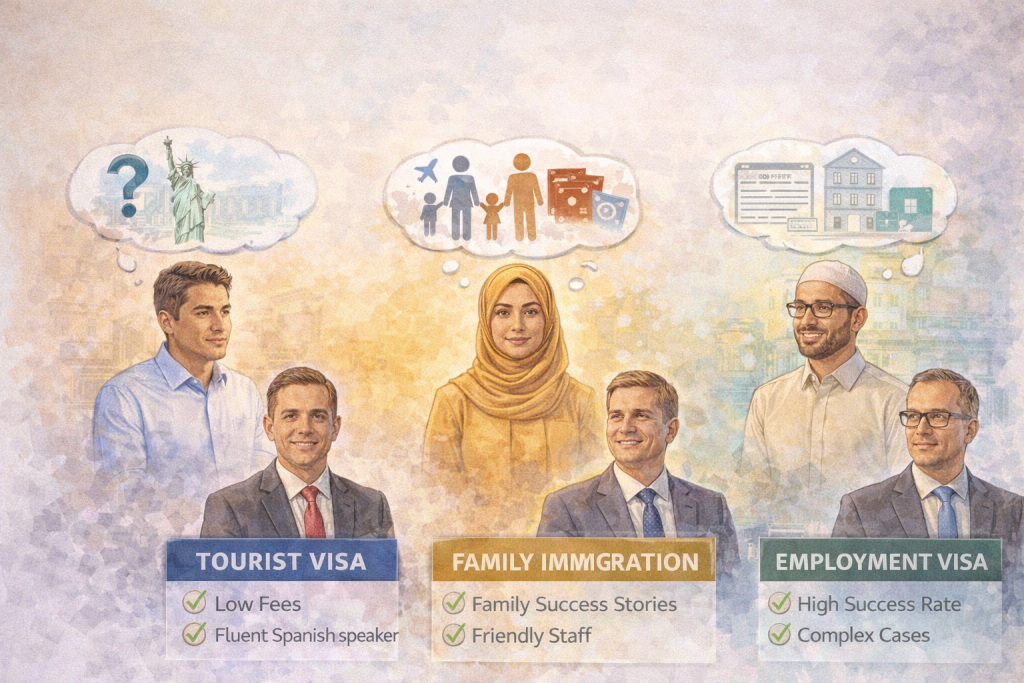
A personal injury client gets in a car accident, searches for a lawyer, calls the first firm with a good Google rating, and retains them within a week. The decision is relatively straightforward. The client is usually a native English speaker, familiar with the legal system, and focused primarily on one question: can this firm win my case?
An immigration client is different in almost every way.
They may be searching in a language other than English. They may be relying on a family member to translate the search results. They may distrust the legal system entirely because of experiences in their home country. They may be making the decision not alone, but with a spouse, a parent, or a community leader who was asked for a recommendation. They may be searching at 10pm on a Saturday because their work schedule does not allow calls during business hours. And they may be so anxious about their situation that the wrong tone on a landing page or the wrong voice on a voicemail makes them hang up and try someone else.
Immigration clients do not choose lawyers the way personal injury clients, family law clients, or criminal defense clients do. And firms that market to them as if they do are leaving cases on the table every month.
How immigration client behavior is different
The differences are not subtle. They affect every part of the marketing and intake process, from how the client finds the firm to how they decide to retain.
1. Trust is built through community, not advertising
In most immigrant communities, the first source of information about a lawyer is not Google. It is a person. A family member who went through the process. A friend from church. A community leader who has referred others before. A post in a WhatsApp group or a Facebook community. A recommendation on a Telegram channel.
By the time many immigration clients search for a firm online, they have already heard a name from someone they trust. The Google search is often confirmation, not discovery. They are typing the firm name into Google to find the phone number, read the reviews, and see whether the website looks trustworthy — not to compare 10 firms and pick the cheapest.
This means the firm’s reputation inside specific communities matters more than its Google Ads budget. A single trusted community member who recommends the firm to 20 families over the course of a year is worth more than $50,000 in paid search. But most firms have no system for identifying, nurturing, or measuring those community relationships.
2. The decision is rarely made alone
Immigration decisions are family decisions. A man facing removal proceedings does not make the call himself — his wife does, after talking to her sister, who talked to a coworker, who retained an attorney last year. A young professional seeking an H-1B sponsor does not choose alone — their parents, often from abroad, weigh in on the decision.
This changes the marketing in two ways. First, the firm’s reputation needs to reach the decision influencers, not just the named client. Second, the consultation process needs to accommodate the fact that the person on the call may not be the person who needs the legal help. The intake coordinator needs to handle calls where a daughter is calling on behalf of her father, where a friend is gathering information for someone who does not speak English, or where a spouse is evaluating three firms and will report back to the family.
3. Language is not optional — it is structural
Many immigration clients are not fully comfortable conducting a legal consultation in English. They may be able to search in English but prefer to speak in their native language when discussing something as serious and personal as their immigration case.
This is not just about having a bilingual attorney available. It affects the entire intake experience:
Landing pages: A Spanish-speaking prospect who clicks on a Google Ad for “abogado de inmigración” and lands on an English-only page with no Spanish option will bounce. The ad promised relevance in their language. The landing page broke that promise.
Phone intake: A caller who reaches an English-only receptionist and cannot communicate their situation clearly will hang up. If the firm serves a large Spanish-speaking, Chinese-speaking, or any other non-English-speaking population, someone on the intake team must be able to take that call in the client’s language.
Confirmation messages: A consult confirmation text sent in English to a client who primarily reads in Spanish is less effective than one sent in their preferred language. The point of the message is to reduce anxiety and increase commitment. If the client cannot easily read it, it fails.
Consultation itself: If the attorney conducts the consultation in English and the client is only partially following, the client leaves feeling uncertain rather than reassured. They are less likely to retain. Not because the attorney was not good, but because the communication gap made it impossible for the client to feel confident in the advice.
4. Searches happen after hours
Immigration clients disproportionately search for legal help outside of standard business hours. Many work hourly jobs in construction, hospitality, food service, cleaning, or other industries where stepping away to make a phone call at 2pm is not possible. They search at night, on weekends, during lunch breaks, and on their commute.
A firm that only answers calls and responds to forms during 9–5 Monday through Friday is invisible to a significant portion of its potential client base. Not because the firm does not appear in search results — it might rank beautifully — but because the response comes 14 hours after the inquiry, by which time another firm has already made contact.
This is not a minor edge case. After-hours form fills often represent 30–40% of total web inquiries at immigration firms. Those are not low-quality leads. They are working people with real legal needs who can only search for help when their day is done.
5. Distrust of the legal system is real and rational
Many immigration clients come from countries where the legal system is corrupt, where government interaction means danger, or where lawyers are associated with exploitation rather than protection. That distrust does not disappear when they arrive in the United States. It shapes how they evaluate a law firm.
A sterile, corporate-looking website with stock photos and legal jargon may feel trustworthy to an American-born client seeking a personal injury attorney. To an immigrant who has learned to be cautious about anyone who holds power over their legal status, that same website may feel cold, impersonal, and intimidating.
Trust signals that work for immigration clients are different: a photo of the actual attorney (not a stock image), a personal story or background that shows cultural understanding, reviews from people in their community, multilingual content, and a tone that communicates empathy rather than authority. These are not nice-to-haves. They are the difference between a prospect who retains and a prospect who keeps searching.
What this means for how the firm markets
Understanding immigration client behavior is not an academic exercise. It has direct, practical implications for every layer of the firm’s marketing and intake system.
Multilingual landing pages
If the firm serves a significant non-English-speaking population, the website needs landing pages in that language — not machine-translated pages that read like a robot wrote them, but real pages written in the client’s language with the same care and specificity as the English version. If the firm runs Google Ads targeting Spanish-language keywords, the ad should click through to a Spanish-language landing page. Matching the client’s language from ad to page to form to confirmation is what converts a click into a consult.
Community-specific trust signals
Reviews from clients in the community the firm serves are more persuasive than any ad. A Google review that says “Abogado Dyakov helped my family with our green card. He speaks our language and understood our situation” does more work than a $5,000/month SEO campaign. The firm should actively request reviews from satisfied clients, especially in the languages and communities it serves. Display these reviews prominently on the website and in Google Ads extensions.
Extended intake hours and after-hours response
The firm’s intake system must be built for the reality that many immigration clients cannot call during business hours. This means, at minimum, an after-hours auto-response with a scheduling link, a missed-call text-back system, and online booking available 24/7. Ideally, it also means extended live intake hours — even if just until 7 or 8pm — to capture the evening search window when many working immigrants are looking for help.
Consult confirmation in the client’s preferred language
The 3-touch confirmation sequence should be available in the client’s preferred language. If the firm logs preferred language during intake, the confirmation and reminder messages can be sent in that language automatically. This is not just good marketing. It is good client experience. A consult reminder in the client’s language reduces no-show rates more effectively than the same message in English because it feels personal rather than institutional.
Referral systems built around community networks
Since community trust is the dominant acquisition channel for most immigration firms, the firm should have a deliberate referral strategy — not just hoping past clients tell their friends. This means identifying the community leaders, organizations, religious institutions, ethnic media outlets, and social media groups where the firm’s clients come from. Building relationships there. Showing up at community events. Being present in the WhatsApp groups and Facebook communities where immigration questions are discussed. Not with advertising, but with presence, helpfulness, and trust.
Track every referral source in the CRM. Over time, the data will reveal which community relationships produce the most retained cases — and the firm can invest its relationship-building time accordingly.
What generic legal marketing gets wrong
Most legal marketing agencies approach immigration firms the same way they approach personal injury firms or family law firms. They build English-only landing pages. They optimize for keywords without considering language or community dynamics. They measure clicks and impressions without understanding that the trust journey for an immigration client is longer, more community-dependent, and more emotionally complex than for most other practice areas.
The result is campaigns that look good on paper but underperform in practice. The ads are well-written. The landing pages are optimized. The SEO strategy is sound. But the campaigns fail to account for:
The client who clicks the ad but bounces because there is no Spanish option.
The client who calls at 7pm and gets voicemail because intake closes at 5.
The client who books a consult but no-shows because the confirmation was in a language they struggle to read.
The client who retains a competitor because their cousin recommended someone and community trust outweighed everything else.
The client who found the website but felt uncomfortable because the tone was corporate, the photos were stock, and nothing on the page signaled cultural understanding.
None of these failures show up in the agency report. The report shows clicks, traffic, and leads. It does not show the prospect who left the landing page in 8 seconds because it was in the wrong language. It does not show the caller who hung up because they could not communicate with the receptionist. It does not show the consult that never happened because the confirmation text was not in the client’s language.
Generic legal marketing misses half the picture for immigration firms. The half it misses is exactly where the cases are won and lost.
The firms that understand this have an unfair advantage
An immigration firm that builds its marketing and intake system around how immigration clients actually behave — not how legal clients in general behave — has an advantage that no amount of ad spend can buy.
That firm answers calls at 7pm. That firm sends confirmation texts in Spanish. That firm’s website has a real photo of the attorney and a story that signals cultural understanding. That firm tracks which community leaders send the most referrals and invests in those relationships. That firm’s intake coordinator asks “¿Prefiere hablar en español?” in the first 10 seconds of the call.
These are not expensive changes. They do not require a bigger budget, a new agency, or a technology overhaul. They require understanding the client. And that understanding is the one thing that most legal marketing agencies — no matter how competent — do not bring to the table.
Immigration clients choose lawyers differently. The firms that build their growth systems around that difference will always outperform the ones that treat immigration marketing like every other practice area.
Lexfull helps immigration law firms fix intake, visibility, and growth execution.
If your firm serves immigrant communities and your marketing does not reflect how those communities actually find and choose lawyers, book a Growth Diagnostic and we will show you where the gaps are.