
It is 8:42 p.m. on a Tuesday.
The managing partner is not reviewing case strategy. Not preparing for tomorrow’s hearing. Not calling a client back.
She is inside Google Ads, then the CRM, then a spreadsheet, then a vendor email thread.
She is trying to answer questions that should not belong to her desk in the first place.
Why did paid leads drop this month?
Why are consultations booked but not held?
Why is the intake team tagging sources three different ways?
Why is the agency saying performance is strong when retained cases are flat?
That is the accidental CMO problem in a law firm.
The partner did not decide to become a marketing operator. The role found her anyway.
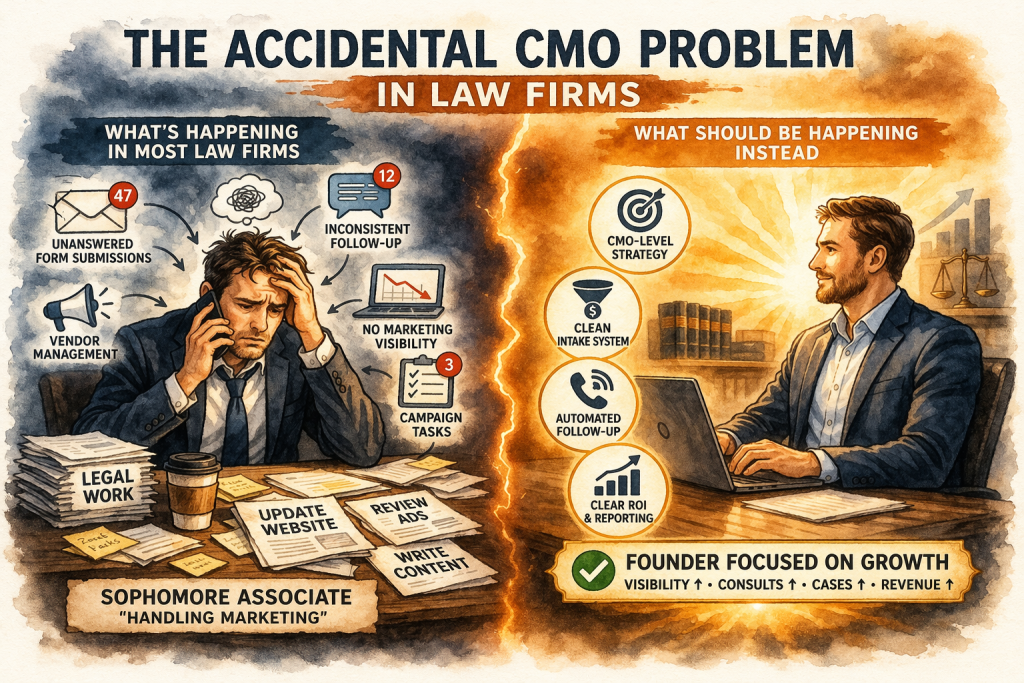
This happens in more firms than people admit. The law firm owner as CMO becomes the default model when nobody owns the system between inquiry and retained case. Marketing activity exists. Intake exists. A billing system exists. Vendors exist. But the operator layer that connects all of it is missing.
So the partner managing marketing fills the gap with nights, weekends, instinct, and fragmented oversight.
The result is not control. It is hidden chaos.
And in immigration law firms, that chaos is expensive because the buyer journey is emotional, time-sensitive, multilingual, and often spread across multiple channels, including Google Ads, Local Services Ads, referrals, community visibility, direct traffic, and after-hours inquiries.
That is why this is not just a leadership problem. It is a growth problem, a revenue visibility problem, and a retained-case problem.
If your firm has an accidental CMO problem, the issue is not that the managing partner cares too much. The issue is that the firm built growth around executive heroics instead of a system.
How managing partners become accidental CMOs
Very few law firm owners wake up and say, “I want to run growth operations myself.” It happens gradually.
An agency sends reports that do not connect to retained cases, so the partner starts checking the numbers personally.
The intake team misses a few leads, so the partner starts listening to calls.
The CRM is messy, so the partner creates a separate spreadsheet.
A directory renews automatically, and nobody can say whether it works, so the partner starts reviewing vendor spend line by line.
At first, this feels responsible. It feels like ownership.
Then it becomes a second job.
In many small and midsize immigration firms, the managing partner becomes the accidental CMO because the business has no clear owner for five things: lead capture, intake process, pipeline hygiene, vendor accountability, and revenue reporting.
When nobody owns those five, the partner becomes the final reviewer of everything.
That is not strategic leadership. That is system compensation.
You can see it in the weekly pattern. The partner reviews dashboards at night, responds to vendor emails between matters, asks the intake team for updates in the hallway, and tries to reconstruct ROI from billing records on Sunday.
That model can survive for a while. It does not scale well.
It is also why many accidental CMO lawyers feel busy all the time and informed almost none of the time. They touch every part of growth, but they still cannot answer the one question that matters: what did we spend, and what did we get?
Why the accidental CMO model breaks scaling
The first problem is time.
Every hour a managing partner spends chasing marketing details is an hour not spent practicing law, developing referral relationships, mentoring the team, or making higher-level business decisions. The direct cost is attention. The indirect cost is delay.
The second problem is inconsistency.
When the law firm owner as CMO is the only person who understands how marketing, intake, and revenue fit together, the system works only when that person is actively involved. The second she gets pulled into hearings, emergencies, or casework, the operating rhythm breaks.
The third problem is weak decision quality.
Most partners are forced to make growth decisions from partial information. They see clicks but not cases. They hear opinions from vendors but not source-level profitability. They know which channels feel busy, but not which ones produce retained matters at the best cost.
The fourth problem is team dependency.
If the partner remains the only real owner of growth logic, nobody else develops operational judgment. The intake coordinator becomes reactive. The office manager stays administrative. Vendors manage themselves. The firm never creates a growth function. It only creates more partner burden.
The fifth problem is hidden leakage.
In immigration firms, the gaps are usually not dramatic. They are small and repeated. A missed call after hours. A form that waits until morning. A consultation with no reminder. A referral source logged as “friend.” A Google Ads campaign with decent traffic and weak intake follow-up. None of those failures looks catastrophic in isolation. Together they destroy efficiency.
This is why the accidental CMO law firm is such an important concept. It names a pain that many owners feel but do not describe clearly. They think they need a better agency, a better website, or more leads. Often what they need is a real operator layer.
What the operator layer actually owns
The missing layer between marketing activity and revenue outcomes should own the system, not just the channels.
That means five areas.
1. Inquiry capture and response. Someone has to own how calls, forms, missed calls, texts, and after-hours inquiries are handled. That includes service-level expectations, response workflows, scheduling, reminders, and recovery.
2. Pipeline structure. Someone has to define the stages from new lead to retained case, make sure they are used consistently, and keep source tagging clean enough to trust.
3. Vendor management. Someone has to translate agency activity into business outcomes, review the right numbers, challenge weak reporting, and connect outside work to inside performance.
4. Revenue visibility. Someone has to ensure the firm can see leads by source, consults by source, retained cases by source, cost per retained case, and basic trends over time.
5. Weekly execution. Someone has to run a cadence. Not a random pile of updates. A recurring operating rhythm with metrics, priorities, owners, and deadlines.
This is the work most generic agencies do not own. They run campaigns. They may improve rankings. They may send reports. But they usually do not manage intake discipline, CRM logic, consult flow, source integrity, or weekly operating cadence inside the firm.
That gap is exactly where many immigration firms lose money.
And that is also why a partner managing marketing feels permanently half-satisfied. Marketing is active, but the business outcome is still unclear.
What good looks like inside an immigration law firm
Good does not mean the managing partner disappears from growth. It means the partner stops being the system.
A healthy model usually looks like this:
The firm has one owner of growth operations. That may be an internal operator, a strong office manager with the right support, or an immigration-only fractional growth partner.
The intake team works from a defined process, not memory.
The CRM has simple stages, consistent source tagging, and clear accountability.
Every active vendor is reviewed against business metrics, not vanity metrics.
The managing partner sees one clean dashboard and joins one short weekly review.
The partner makes directional decisions. The operator owns execution follow-through.
That is the replacement for the accidental CMO model. Not less oversight. Better oversight.
In practical terms, most partners should see five things every week.
Leads by source.
Consultations scheduled and held.
Retained cases by source.
Response time and missed-call performance.
Cost per retained case, or at minimum, a credible path to it.
That is enough to run the business much more intelligently than most firms do today.
It is also enough to stop wasting partner attention on activity that does not change outcomes.
A simple workflow for replacing the law firm owner as CMO
If a firm wants to move out of the accidental CMO trap, the shift usually happens in four steps.
Step 1: define ownership.
Decide who owns the middle. Not who owns ads. Not who answers the phone. Who owns the connection between lead, consult, retained case, and reporting. If the answer is still “the partner, mostly,” the problem is still alive.
Step 2: simplify the pipeline.
A lot of firms do not need a more complex CRM. They need a cleaner one. New Lead. Contacted. Consult Scheduled. Consult Held. Retained. Not Retained. That alone removes a surprising amount of confusion.
Step 3: standardize weekly review.
Run one 15-minute meeting. Review the same numbers every week. Identify what broke, what was fixed, and what matters next. The goal is not a long meeting. The goal is fewer surprises.
Step 4: manage vendors through outcomes.
Ask every outside vendor the same question: what changed in consults, retained cases, and cost per retained case because of your work? If they cannot connect their activity to the firm’s operating reality, they are managing channels, not growth.
Notice what is missing from this workflow. There is no magic software recommendation. No promise that a new campaign solves everything. No suggestion that more dashboards automatically create clarity.
The shift is operational. Somebody owns the system. The data gets cleaner. The cadence becomes real. The partner gets out of the weeds without losing visibility.
Common mistakes firms make when they try to fix this
Mistake 1: hiring another agency and expecting the structure problem to disappear.
A new vendor can improve a channel. It usually cannot repair internal ownership on its own.
Mistake 2: overbuilding the CRM.
Too many custom fields, too many stages, and too much optional data create theater, not clarity.
Mistake 3: measuring leads without measuring outcomes.
Lead volume matters. But if the firm cannot see consults, retained cases, and source quality, lead reporting becomes false comfort.
Mistake 4: treating intake as administrative instead of strategic.
In immigration law, intake is not a front-desk function. It is part of growth. It shapes contact rate, show rate, trust, and conversion.
Mistake 5: keeping all decisions inside the managing partner’s head.
When priorities, definitions, and standards are undocumented, the firm becomes dependent on memory. Memory does not scale.
Mistake 6: accepting generic legal marketing advice.
Immigration buyers behave differently. They search after hours. They may want another language. They often decide under stress. They may involve family or community in the decision. A system that ignores those realities will always underperform, even if the ad account looks fine.
Why an immigration-only fractional growth partner can outperform a generic agency
A generic agency usually wins or loses on campaign work. An immigration-only fractional growth partner wins or loses on operating clarity.
That distinction matters.
Generic agencies often optimize what they can touch directly, ads, rankings, traffic, forms, and reports. An immigration-only operator looks at the handoff after the click. Did someone answer? Was the lead tagged correctly? Was the consult confirmed? Did the source reach the retained-case report? Did the managing partner see the right signal on Monday?
That is the difference between channel management and growth leadership.
It also matters because immigration firms have a specific buyer journey. The language on the page matters. The response window matters. The trust signals matter. The intake experience matters. The difference between family cases, removal matters, humanitarian matters, and employment work matters.
A generic agency may know legal ads. It often does not know immigration-firm operations.
An immigration-only fractional growth partner can outperform because the work is not limited to generating activity. It includes translating activity into consults, retained cases, revenue visibility, and time back for the partner.
That is what many Lexfull buyers are actually paying for. Not more dashboards. Not more marketing theory. A business that feels less chaotic and performs with more clarity.
A practical self-assessment for managing partners
If you want to know whether your firm has an accidental CMO problem, ask yourself these seven questions.
Do I review marketing or intake issues at night or on weekends?
Can I name which channels produced retained cases last month?
Do vendors define success differently than I do?
If I disappeared for two weeks, would growth decisions keep moving?
Can my team tell me the current response-time standard without guessing?
Is there one owner of the space between inquiry and retained case?
Do I trust the CRM enough to make budget decisions from it?
If more than two of those answers make you uncomfortable, the law firm owner as CMO model is probably still running your business.
That does not mean your firm is broken. It means the system has not been built yet.
The good news is that this problem is fixable faster than most partners think. Usually the first gains do not come from more traffic. They come from cleaner ownership, cleaner data, and a better operating rhythm.
That is how consult volume becomes more predictable. That is how retained-case visibility becomes real. That is how vendor accountability becomes normal instead of emotional. And that is how the managing partner gets time back without giving up control.
The accidental CMO problem in law firms is not really about marketing. It is about what happens when growth has activity but no owner.
Fix that layer, and a surprising amount of the rest starts to make sense.
Lexfull helps immigration law firms replace owner-led marketing chaos with an operating system for intake, visibility, and retained-case growth.
If your firm has a partner managing marketing because nobody owns the middle, book a diagnostic and we will show you exactly where the system is breaking, what should be measured, and what to replace it with.