
The managing partner of an immigration firm does not need more meetings. They already have too many. Staff meetings. Client meetings. Vendor calls. Court hearings. USCIS deadlines. The calendar is full and the inbox is overflowing.
But there is one meeting that most immigration firms do not have — and its absence is the reason the managing partner spends 10+ hours per week on growth-related chaos that should not require their involvement at all.
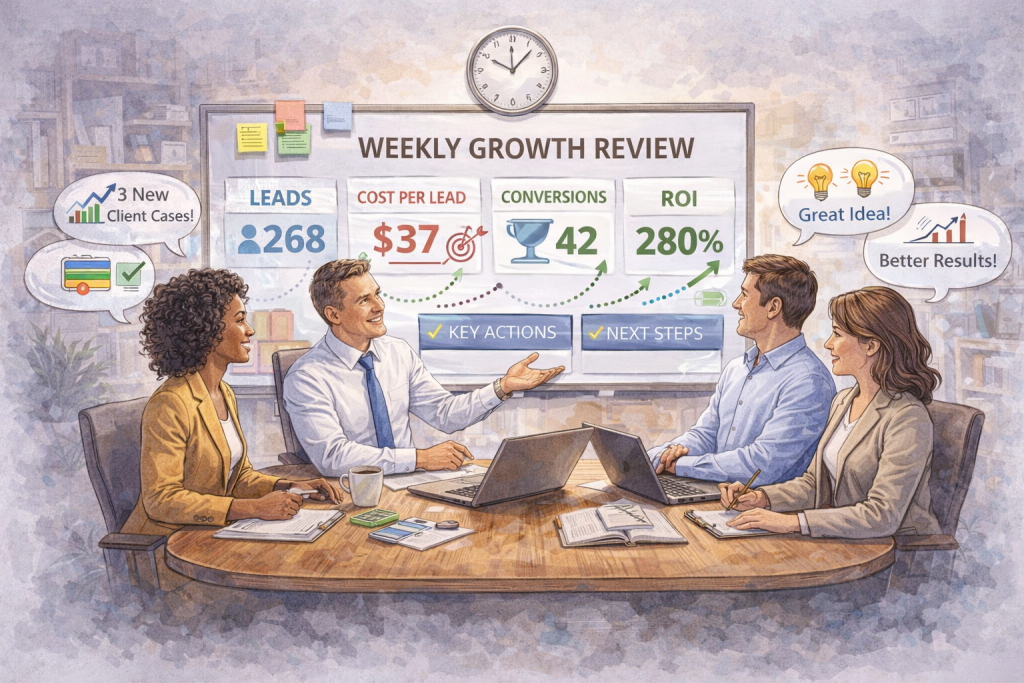
That meeting is a 15-minute weekly growth review. It happens every Monday morning. It follows a fixed agenda. It produces specific decisions. And it replaces every other unstructured, reactive, time-consuming way the managing partner currently tries to stay on top of marketing, intake, and growth.
One structured 15-minute meeting per week eliminates the 10pm dashboard checks, the Sunday spreadsheet sessions, the mid-hearing vendor emails, and the constant low-grade anxiety of not knowing whether the growth system is working.
Why this meeting does not exist at most firms
Most immigration firms do not have a weekly growth review because they do not have the three prerequisites that make it possible:
1. They do not have the numbers. A 15-minute review requires a dashboard with 5 clear KPIs. If those numbers do not exist — if nobody is tracking leads by source, consults, retained cases, cost per case, and response time — there is nothing to review. The partner fills the gap by manually reconstructing the data from memory, billing records, and agency reports. That takes hours, not minutes.
2. They do not have someone to run it. The weekly review should not be run by the managing partner. It should be run by whoever owns growth operations — an office manager, an operations coordinator, a fractional growth partner, or anyone who is accountable for the intake-to-retained-case pipeline. At most firms under 20 attorneys, that person does not exist. The partner runs growth by default, which means any meeting about growth is just the partner talking to themselves.
3. They do not have a cadence. Growth decisions at most immigration firms happen reactively. The partner notices that cases seem slow this month. The partner gets frustrated with the agency after a bad report. The partner fires someone on the intake team after discovering missed calls. These are not decisions made from a weekly cadence. They are reactions to crises. A weekly meeting prevents the crises by catching problems before they compound.
The solution is not complicated. It is a meeting with a fixed agenda, a fixed time, and a fixed set of numbers. Here is exactly what it looks like.
The exact 15-minute agenda
This meeting happens every Monday morning. Same time every week. Non-negotiable. It is not rescheduled for hearings, staff issues, or vendor calls. Fifteen minutes is short enough that it can fit into any calendar.
Minutes 0–3: Review last week’s numbers
The person running the meeting opens the dashboard and reads five numbers out loud:
1. Leads by source: How many new leads came in last week? From which channels? Was this up, down, or flat compared to the prior four-week average?
2. Consultations scheduled and held: How many consults were booked? How many actually happened? What was the show rate?
3. Retained cases: How many new cases were signed? From which sources?
4. Cost per retained case: What did each retained case cost to acquire this period? Is the number healthy or trending in the wrong direction?
5. Response-time performance: What percentage of leads were contacted within the SLA? How many calls were missed? How many form fills waited more than 2 hours?
This takes 3 minutes because the dashboard is already built and the numbers are already there. Nobody is calculating anything in real time. The person running the meeting simply reads what the system shows.
If this step takes more than 3 minutes, the dashboard is not built correctly. Fix the dashboard, not the meeting.
Minutes 3–8: What broke and what was fixed
This is the diagnostic section. Based on the numbers, the person running the meeting identifies:
What broke last week. Examples: lead volume dropped 30% because the Google Ads budget ran out on Thursday. The show rate was 55% because the confirmation sequence was not firing after a CRM update. Three form fills sat uncontacted for 72 hours because the intake coordinator was out sick and nobody covered.
What was fixed last week. Examples: the missed-call text-back was implemented and recovered 4 after-hours leads. The no-show recovery sequence was activated and rebooked 2 consultations. The agency shifted $1,500 from a low-performing campaign to the one producing retained cases.
This section is not a blame exercise. It is a system diagnostic. Things break every week in every firm. The question is whether the breaks were caught, fixed, and documented — or whether they went unnoticed until the managing partner stumbled across them at 10pm.
The managing partner’s role in this section is to listen, ask clarifying questions, and flag anything that seems off. They do not need to solve the problem. They need to know it exists and that someone is handling it.
Minutes 8–13: This week’s priorities
Based on the numbers and the diagnostic, the person running the meeting proposes 1–3 priorities for the coming week. Not 10 priorities. Not a vague “improve marketing.” One to three specific, actionable items.
Examples:
Priority 1: Fix the confirmation sequence that stopped firing. QA the full flow by Tuesday. Confirm it is working for all new bookings by Wednesday.
Priority 2: Review last month’s LSA performance. Cost per lead has increased 40% over 60 days. Determine whether to adjust targeting, pause, or reallocate budget. Recommendation due by Friday.
Priority 3: Train the new intake coordinator on the source tagging protocol. Complete by Thursday so next Monday’s numbers are clean.
Each priority has an owner, a deadline, and a clear definition of done. The managing partner approves the priorities, flags any concerns, and moves on.
Minutes 13–15: Document decisions
The person running the meeting writes down three things in a shared document, Slack channel, or email:
1. This week’s numbers (the 5 KPIs, one line each).
2. What broke and what was fixed (2–3 bullets).
3. This week’s priorities with owners and deadlines (1–3 items).
This documentation takes 2 minutes. It creates a running log that the firm can look back on in 90 days and see: here is what we focused on each week, here is what changed, here is how the numbers moved. That log is more valuable than any monthly agency report because it shows the decision trail, not just the data.
The entire meeting fits on a single page of notes. If the notes are longer than one page, the meeting was too long.
Who runs this meeting (and why it should not be the managing partner)
The single most important design decision in this meeting is who runs it.
It should not be the managing partner.
The managing partner should attend for 15 minutes, review the numbers, ask questions, approve priorities, and leave. If the partner runs the meeting, they are still the central node in the growth system. The meeting becomes another task on the partner’s plate instead of a task that is taken off it.
The person who runs the weekly growth review should be whoever owns the growth pipeline day to day:
An office manager or operations coordinator who already handles intake and vendor communication. Many firms have someone in this role who simply has not been given a structured framework to work within.
A senior intake coordinator who understands the pipeline and has the organizational skills to run a short, structured meeting.
A fractional growth partner or external operator who owns the growth system professionally and runs the cadence as part of their engagement.
The key requirement is not seniority or marketing expertise. It is accountability. The person running this meeting is the person who is responsible for knowing the numbers, catching the breaks, and proposing the fixes. The managing partner is the person who reviews, decides, and moves on.
What this meeting eliminates
Once the weekly growth review is running consistently, the managing partner should notice several things disappearing from their week:
The 10pm dashboard check. The partner no longer needs to open Google Ads at night to see if things are working. The numbers are reviewed every Monday morning. If something is wrong, it will surface in the meeting. The partner can close the laptop after dinner.
The Sunday spreadsheet session. The partner no longer needs to manually count cases, reconcile agency reports, or build ad-hoc tracking sheets. The dashboard exists. The weekly review reads it. The partner’s Sunday morning is returned to them.
The mid-hearing vendor email. The partner no longer needs to answer the agency’s “quick question” between court appearances. The person running the weekly review handles vendor communication during the week. The partner sees the summary on Monday.
The reactive crisis. The partner no longer discovers missed calls two weeks after the fact, or realizes the agency blew through the budget mid-month, or finds out the intake coordinator was not tagging leads. These issues get caught in the weekly review when they are small and fixable instead of when they have already cost the firm cases.
The ambient anxiety. The partner no longer carries the background stress of not knowing whether the growth system is working. Every Monday, they see the numbers, hear the summary, approve the priorities, and move on with clarity. That mental space is worth more than any time savings.
How to start this week
You do not need a consultant, a new tool, or a training program to implement this. You need four things:
1. A dashboard with 5 numbers. If you do not have one, build it this week using the framework from Article 5 and Article 11. It can be a CRM report, a Google Sheet, or a Notion page. The format does not matter. The numbers do.
2. A person to run the meeting. Identify the person in your firm who is closest to the intake pipeline and growth operations. Tell them: “Starting Monday, you are running a 15-minute growth review. Here is the agenda. Here are the 5 numbers. Your job is to know them, tell me what broke, and propose what we focus on this week.”
3. A recurring calendar invite. Monday morning. 15 minutes. Every week. Non-negotiable. Put it on the calendar today.
4. A shared document for notes. A Google Doc, a Notion page, a Slack channel, or even a running email thread. Somewhere the 5 numbers, the breaks/fixes, and the priorities get recorded every week. This is your growth log.
The first meeting will be imperfect. The dashboard might be incomplete. The person running it might be nervous. The numbers might reveal uncomfortable truths. That is fine. The second meeting will be better. By week four, the cadence will feel natural. By week eight, the managing partner will wonder how the firm ever functioned without it.
The meeting is not the system
One final point that matters more than anything else in this article:
The weekly growth review is not the growth system. It is how you know the growth system is working.
The system is the dashboard, the pipeline stages, the source tagging, the follow-up sequences, the confirmation workflows, the vendor accountability, and the intake standards. Those run every day, automatically and through people, whether or not anyone is watching.
The weekly meeting is the 15-minute check that confirms the system is running, catches the breaks before they become expensive, and keeps the whole machine moving in the right direction.
Without the system, the meeting has nothing to review. Without the meeting, the system has no accountability. You need both. But the meeting is the easier one to start — and once it exists, it creates the pressure to build the system around it.
The meeting is not the system. The meeting is how you know the system is working. Start the meeting. The system will follow.
Lexfull helps immigration law firms fix intake, visibility, and growth execution.
If your firm does not have a weekly growth cadence and the managing partner is still running growth reactively, book a Growth Diagnostic and we will show you how to build the system and the meeting around it.