
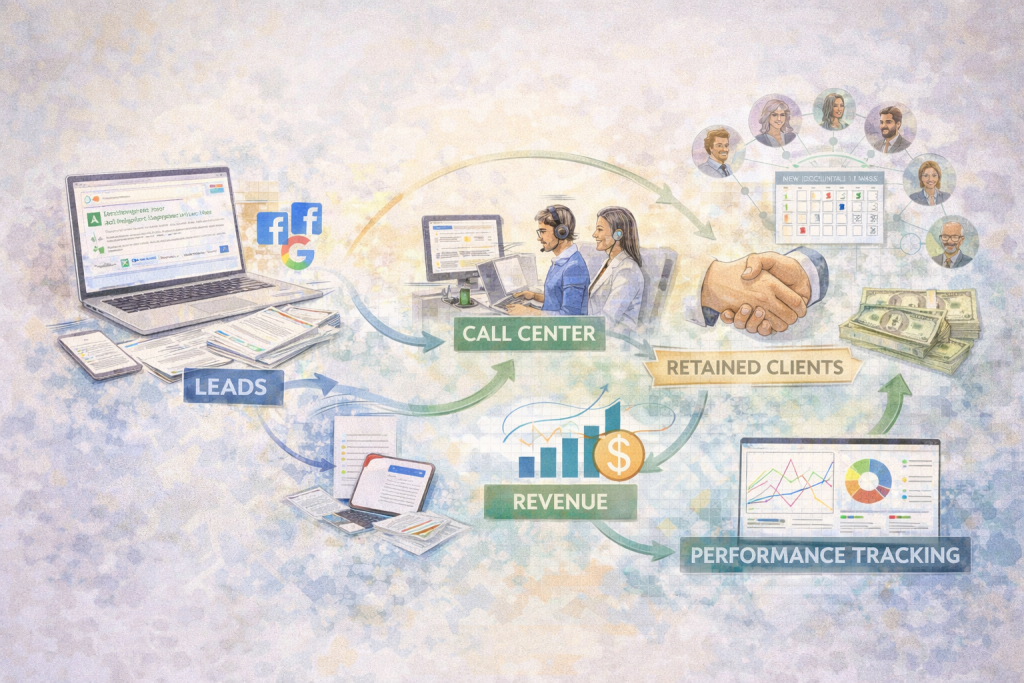
Most managing partners at immigration firms have a rough sense of what they think a growth system should do. It should bring in more cases. It should make marketing less confusing. It should free up the partner’s time. It should produce some kind of return.
What they do not have is a concrete picture of what actually changes, month by month, inside the firm. What does the first week look like? What is different by day 30? By day 90? What does the partner’s Monday morning look like in month six compared to month one?
This article answers those questions. No pitch. No package names. Just the operational reality of what happens when an immigration firm stops managing growth reactively and builds a system around it.
This is based on patterns observed across immigration firms that have implemented structured growth systems. Specific timelines and results vary by firm, but the sequence and milestones are consistent.
Month 1: The audit and the foundation
The first month is not about marketing campaigns. It is about understanding what is broken and building the infrastructure that everything else depends on.
Week 1–2: The diagnostic
Someone walks through every layer of the firm’s growth system and documents what exists, what is broken, and what is missing:
Intake audit. How do leads enter the firm? Who answers the phone? How fast? What happens after hours? What is the follow-up process for missed calls and form fills? Where are leads getting lost between first contact and booked consultation?
Tracking review. Is call tracking installed? Are form fills being logged? Does the CRM have defined pipeline stages? Are leads tagged by source? Can anyone inside the firm tell you how many leads came in last month and from where?
Vendor and channel review. What is the agency doing? What are the ads producing? What does the SEO look like? Are there directory listings the firm pays for but cannot evaluate? Is anyone managing the Google Business Profile?
Revenue leak map. Where between a lead arriving and a case being retained is the firm losing the most? Missed calls? Slow follow-up? No-shows? Consult-to-retainer drop-off? Unmeasured channels? The leak map prioritizes fixes by dollar impact, not by what feels urgent.
Week 2–4: Install the foundation
Based on the diagnostic, the immediate infrastructure gets built:
Call tracking goes live. Every lead source gets a unique number. For the first time, the firm can see which calls come from Google Ads, which come from the GBP listing, and which come from the website.
CRM gets cleaned up. Pipeline stages are defined: New Lead → Contacted → Consult Scheduled → Consult Held → Retained / Not Retained. Unused fields are deleted. Source tagging becomes mandatory.
Dashboard goes live. A single-page view showing leads by source, consults, retained cases, cost per retained case, and response-time performance. Updated weekly. This is what the managing partner will review every Monday for the rest of the engagement.
The biggest intake leak gets fixed. Whatever the diagnostic identified as the highest-dollar leak — usually missed calls, slow follow-up, or after-hours silence — gets addressed in the first 30 days. An after-hours auto-response goes live. A missed-call text-back system gets installed. A follow-up sequence gets built. The single fix that prevents the most revenue loss happens first.
By the end of month one, the firm has visibility it never had before. The dashboard exists. The biggest leak is patched. The foundation is built. The partner can already see where leads come from and what happens to them.
Month 2: The system starts running
Month two is where the intake system gets tightened and the weekly cadence takes shape.
Follow-up sequences go live. The 3-touch consultation confirmation sequence (immediate confirmation, 24-hour reminder, 1-hour reminder) is built and automated. The no-show recovery workflow (15-minute text, 24-hour email, 48-hour final text) is activated. Every booked consultation now has a structured path from booking to attendance.
Consult show rate starts improving. Firms that implement the confirmation and recovery workflows typically see show rates move from 60–65% to 75–85% within the first full month of operation. That is 3–6 additional consultations that actually happen each month from the same booking volume. At a 40–50% consult-to-retainer rate, that is 1–3 additional retained cases per month.
The weekly growth review begins. Every Monday morning, 15 minutes. The 5 KPIs are reviewed. What broke last week is identified. What was fixed is documented. This week’s priorities are set. The managing partner attends, reviews, approves, and moves on. This meeting replaces the 10pm dashboard checks and the Sunday spreadsheet sessions.
Intake responsiveness gets measured. For the first time, the firm knows its average response time to new leads. The number is usually uncomfortable. But once it is visible, it becomes improvable. The intake team knows they are being measured. Response times start tightening naturally.
Source tagging accumulates real data. After 30–45 days of consistent tagging, the firm has enough data to see which sources are producing leads and which sources are producing retained cases. The picture is still early, but patterns emerge. Google Ads might be generating volume. Referrals might be generating the highest-value matters. The GBP listing might be quietly producing cases nobody knew about.
Month 3: Visibility arrives
Month three is the turning point. The infrastructure is built. The processes are running. Now the data starts telling the truth.
Cost per retained case becomes visible for the first time. With 60–90 days of source-tagged pipeline data, the firm can now calculate: Google Ads produced X retained cases at $Y per case. LSAs produced X at $Y. Referrals produced X at essentially zero. The directory listing produced X at $Y. For most managing partners, this is the first time they have ever seen this number. It changes how they think about every marketing dollar.
The vendor gets held to real KPIs. The agency report is no longer evaluated on clicks and impressions. It is evaluated alongside the firm’s own retained-case data. The conversation shifts from “are we getting leads?” to “which of those leads became retained cases and what did they cost?” The agency either steps up or the firm has the data to make an informed decision about whether to continue.
Budget decisions become rational. If Google Ads produces retained cases at $2,800 each and the average case fee is $5,500, the math says increase spend. If a $400/month directory listing has produced zero trackable cases in 90 days, the math says cancel. These are not gut decisions anymore. They are data decisions.
The managing partner’s growth involvement drops to one weekly check-in. The 15-minute Monday review is now routine. The partner sees the numbers, hears the summary, makes 2–3 decisions, and goes back to practicing law. The 10pm dashboard checks are gone. The vendor emails are handled by someone else. The intake team has documented processes. The partner’s involvement in growth has shifted from 10–12 hours of chaos per week to 15 structured minutes.
Month three is where the managing partner first feels the shift. Growth is no longer something they manage reactively. It is something a system runs, and they oversee.
Months 4–6: The system compounds
The foundation is built. The cadence is running. The data is flowing. Now the system starts compounding.
Conversion gains layer on top of each other. Better response time means more leads contacted. More leads contacted means more consults booked. Better confirmation sequences mean more consults held. Better consult preparation means higher retainer rates. Each improvement feeds the next. A firm that improves from 3% to 5% overall inquiry-to-retained-case conversion doubles its retained cases from the same lead volume without spending an additional dollar on marketing.
Referral tracking reveals hidden leverage. By month four, the CRM has enough referral data to identify the firm’s top referral sources by name. The managing partner can see: Mrs. Garcia referred 6 cases this quarter, and 4 retained at an average fee of $5,800. Pastor Rodriguez’s church community produced 3 cases worth $14,000 total. The firm starts investing deliberately in those relationships instead of treating referrals as random.
The vendor relationship either strengthens or ends cleanly. Three to four months of retained-case data by channel gives the firm a clear, fair evaluation of the agency’s performance. If the agency is producing retained cases at a healthy cost, the relationship is validated and the firm can confidently increase investment. If the agency’s leads are not converting into retained cases, the firm has the data to exit and either bring the function in-house or find a better fit — without guessing.
The partner starts thinking about growth differently. Instead of asking “is our marketing working?” the partner starts asking “where should we grow next?” Should the firm expand into a new case type? Open a second market? Invest in content that captures organic traffic? Add a second language to the website? These are strategic questions that were impossible to think about when the partner was buried in operational chaos. They become natural once the system is running and the data is clear.
The firm’s Monday morning looks different. The managing partner arrives, reviews the dashboard over coffee, joins a 15-minute growth review, makes a few decisions, and walks into the first hearing of the day with a clear head. No vendor emails to answer. No intake fires to put out. No spreadsheets to build. No anxiety about whether the money is being wasted. The system is running. The partner is practicing law.
What did not change
To be clear about what a growth system does not do:
It does not guarantee a specific number of cases. No system can promise outcomes in a market that depends on client decisions, case viability, and competitive dynamics. What the system guarantees is visibility, accountability, and process — which are the conditions under which growth becomes manageable instead of chaotic.
It does not replace the agency. The growth system works alongside existing vendors. It makes their work more visible and more accountable, which either strengthens or clarifies the relationship. But the system itself is not running Google Ads or writing blog posts. It is running the pipeline, the measurement, and the cadence that make everything else evaluable.
It does not eliminate the managing partner from growth entirely. The partner still makes strategic decisions: where to invest, which markets to pursue, whether to add capacity. What changes is that those decisions happen in a 15-minute Monday meeting based on data, not in a 10pm panic based on a vague sense that something is wrong.
It does not work instantly. Month one is infrastructure. Month two is process. Month three is when visibility arrives. Months four through six are when the system compounds. Firms that expect retained-case improvements in week two are setting the wrong expectation. Firms that commit to 90 days almost always see the shift.
The question this article is designed to answer
If you are a managing partner at an immigration firm and you have read this far, you were asking one question: what would actually change if we invested in this?
The answer is not “more leads.” The answer is not “better ads.” The answer is not a dashboard that nobody looks at or a report that nobody reads.
The answer is: you would know where your cases come from, what they cost, and where the system is leaking. You would have a weekly cadence that runs without you in the middle of every decision. You would stop managing growth reactively and start managing it from a single page, once a week, in 15 minutes.
That is what changes. Not overnight. Over 90 days. And then it compounds.
The system does not produce growth by magic. It produces growth by making the entire pipeline — from marketing spend to retained case — visible, measurable, and accountable. Everything that is visible can be improved. Everything that is improved produces more retained cases from the same effort. That is how the math works.
Lexfull helps immigration law firms fix intake, visibility, and growth execution.
If your firm is ready to stop managing growth reactively and start building the system behind it, book a Growth Diagnostic and we will show you what month one would look like.