
The law firm intake process is the most expensive workflow most firms never audit. Every marketing dollar, every ad click, every referral, every directory listing — all of it funnels into intake. And for most firms, intake is where 30–50% of potential cases quietly disappear.
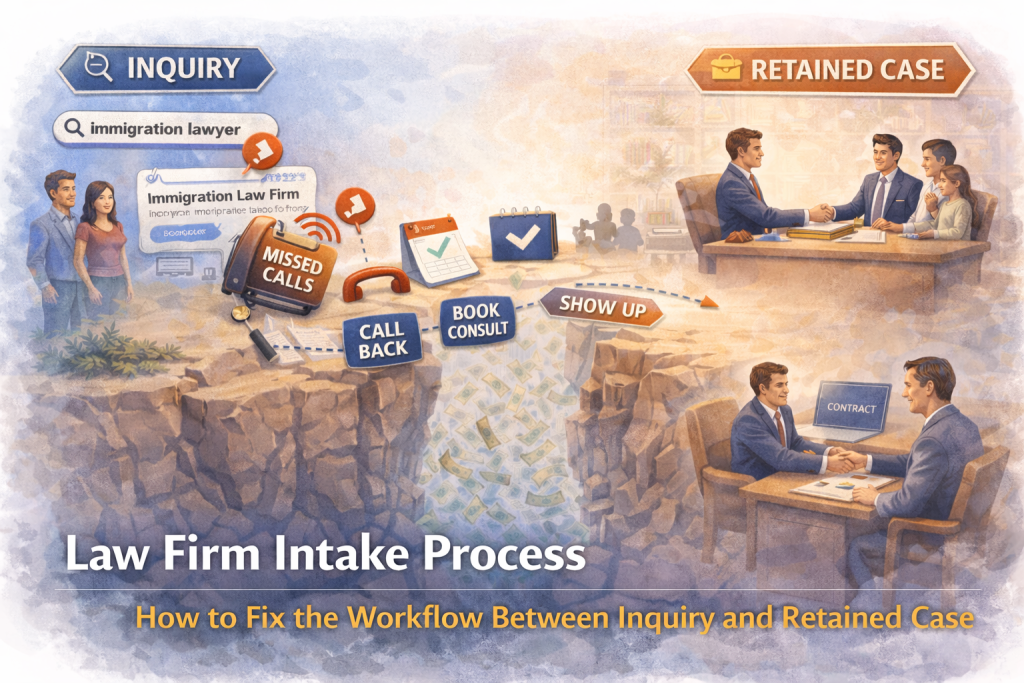
Not because the leads are bad. Not because the ads are wrong. Because the phone goes to voicemail. Because the form fill sits for 6 hours. Because the consultation is booked with no reminder and the prospect does not show. Because the CRM source field says “Phone” instead of the actual channel. Because nobody owns the workflow between first inquiry and signed retainer, and nobody measures where it breaks.
This article is an operator-level guide to fixing the law firm intake workflow for immigration firms with 2–20 attorneys. It covers every stage from first contact to retained case, identifies the most common failure points, provides concrete fixes with implementation timelines, and names the metrics that tell you whether your attorney intake process is working or quietly destroying your marketing ROI.
Why intake is the highest-leverage fix in any law firm
Managing partners tend to think about growth as a marketing problem. The firm needs more traffic, more leads, more visibility. So they hire an agency, increase ad spend, or invest in SEO. Those investments can work. But they only work if the system that receives the leads actually converts them.
Consider the math. A firm spends $10,000 per month on marketing and generates 40 leads. With the firm’s current intake process, 50% of leads become consultations (20 consults), 70% show up (14 held consults), and 40% retain (5.6 cases). Cost per retained case: $1,786.
Now improve intake without changing ad spend. Answer rate goes from 70% to 90%. Response time drops from 2 hours to 5 minutes. Show rate moves from 70% to 85% with a confirmation sequence. Retain rate holds at 40%. The same 40 leads now produce: 60% become consults (24 consults), 85% show (20.4 held consults), 40% retain (8.2 cases). Cost per retained case: $1,220.
That is a 46% improvement in cases retained and a 32% reduction in acquisition cost. Same ads. Same budget. Same agency. The only change was operational: answering the phone faster, following up sooner, and confirming consultations.
Most firms try to double retained cases by doubling ad spend. The faster path is usually to fix intake. The leads are already there. The firm is just losing them in the middle.
The 6 stages of the law firm intake process
A functional legal client intake process has six distinct stages. Each one has its own failure mode, its own metrics, and its own fix. Most firms treat intake as one thing — “someone answers the phone.” That lack of granularity is why problems go undiagnosed for months.
Stage 1: Lead capture
What happens: A prospective client contacts the firm. This could be a phone call, a web form submission, a chat message, a text, a social media DM, or a walk-in. The lead enters the system.
What should happen: Every inquiry is logged in the CRM within 60 seconds. The source is tagged automatically (Google Ads, organic, referral with source name, directory, LSA, GBP, other). The contact method is recorded. A timestamp is created. If the lead called and nobody answered, a missed-call text-back fires within 60 seconds.
Common failure: Calls go to voicemail with no callback system. Form fills land in a general email inbox instead of the CRM. Source tagging is inconsistent or blank. Walk-ins and phone referrals are logged as “Phone” with no source detail. The firm has no way to know how many leads came in, from where, or how many were missed.
Key metric: Capture rate — what percentage of total inquiries are logged in the CRM with a valid source tag. Target: 95%+.
Stage 2: First response
What happens: Someone at the firm contacts the lead for the first time. This could be answering the live call, returning a missed call, responding to a form, or replying to a chat.
What should happen: During business hours, live calls are answered within 3 rings. Missed calls are returned within 5 minutes. Form fills receive a human response within 5 minutes and an auto-response within 60 seconds. After hours, every inquiry gets an auto-response within 60 seconds that includes the firm’s name, a scheduling link, and a brief message in the client’s likely language.
Common failure: Average response time is 2–6 hours. After-hours inquiries wait until the next morning. Nobody tracks response time. The intake team does not know there is a standard because nobody has set one. Leads that called at 5:15pm are functionally lost — by 10am the next day, they have already spoken with a competitor who answered at 5:20pm.
Key metric: Speed to lead — minutes between inquiry arrival and first human contact. Target: under 5 minutes during business hours, auto-response under 60 seconds after hours.
Stage 3: Qualification
What happens: The intake team determines whether the lead is a genuine prospective client. Does the person need an immigration attorney? Is it a case type the firm handles? Is the person in a jurisdiction the firm serves? Can they plausibly become a retained client?
What should happen: The intake team follows a scripted qualification flow. It should take 3–5 minutes. The script captures case type, basic facts, urgency, and the prospect’s language preference. Qualified leads move to Stage 4. Unqualified leads are tagged as such in the CRM with a reason code (wrong case type, wrong jurisdiction, seeking free help, not a legal matter) and closed.
Common failure: No script exists. Qualification depends on whoever answers the phone. Some intake staff book consultations for everyone. Others turn away qualified leads because they are unsure. The firm has no data on what percentage of leads are qualified versus unqualified, making it impossible to evaluate lead quality from any marketing channel.
Key metric: Qualification rate — percentage of captured leads that are qualified prospective clients. This number also serves as a feedback mechanism for marketing: if 40%+ of Google Ads leads are unqualified, the targeting needs work.
Stage 4: Consultation scheduling
What happens: A qualified lead is scheduled for a consultation with an attorney.
What should happen: The consultation is booked during the first contact whenever possible. Availability is visible to the intake team in real time. The first available slot is offered within 48 hours. Longer waits increase drop-off. The booking is confirmed immediately with a text and email that includes date, time, attorney name, meeting format (phone, video, or in-person), and a document checklist.
Common failure: The intake team tells the prospect “someone will call you back to schedule.” That callback happens hours or days later. The prospect has moved on. Or the consultation is booked for 10 days out with no interim engagement, and the prospect forgets, gets cold feet, or books with a firm that offered a sooner slot.
Key metric: Lead-to-scheduled-consult rate — percentage of qualified leads who become scheduled consultations. Target: 70–85% of qualified leads.
Stage 5: Consultation held
What happens: The prospect shows up for the consultation and meets with the attorney.
What should happen: A 3-touch confirmation sequence runs between booking and consultation: immediate confirmation, 24-hour reminder, 1-hour reminder. All in the client’s preferred language. The document checklist creates pre-commitment. The prospect arrives prepared and feeling expected. If the prospect does not show, a recovery workflow fires: 15-minute text, 24-hour email with rebooking link, 48-hour final text.
Common failure: No confirmations. No reminders. No document checklist. The prospect books on Monday and hears nothing until the appointment on Thursday — if they remember it. No-show rate: 30–40%. No recovery attempt. The lead is marked “no-show” in the CRM and forgotten. The full acquisition cost is written off.
Key metric: Show rate — percentage of scheduled consultations that are actually held. Target: 80–90%.
Stage 6: Retainer decision
What happens: The prospect decides whether to retain the firm after the consultation.
What should happen: The attorney presents the fee clearly and confidently during the consultation. A retainer agreement is available to sign immediately. For prospects who need time, a structured follow-up sequence begins: 24-hour check-in text, 3-day email with a clear next step, 7-day final outreach. In immigration, many clients need to discuss with family, gather documents, or arrange financing. A firm that gives one consultation and then waits passively loses cases to firms that follow up.
Common failure: No follow-up after the consultation. The attorney assumes the prospect will call back if they want to proceed. They do not. Or the fee is presented vaguely, the prospect leaves confused about cost, and the firm never clarifies. The CRM shows “Consult Held — Pending” for weeks, and then silence.
Key metric: Consult-to-retainer rate — percentage of held consultations that result in a signed retainer. Target: 35–55% depending on case type and whether the firm charges for consults.
These six stages are the law firm intake workflow. Every firm runs through them whether they have documented them or not. The difference between a firm that retains 4 cases per month and one that retains 8 from the same lead volume is usually not better marketing. It is tighter execution at each of these six stages.
8 diagnostic signs your intake process is leaking revenue
Most managing partners suspect their intake is not working well. They feel it in the gap between how busy the phones seem and how few retainers get signed. These are the specific signs that confirm the suspicion and point to where the leak is.
1. You cannot tell how many leads came in last week. If the answer requires checking three systems, asking the front desk, and guessing, lead capture is broken. The CRM should show total leads by source, updated in real time.
2. The intake team does not know the response-time standard. Ask your intake coordinator: “What is our target for responding to a new lead?” If the answer is a shrug or “as soon as we can,” there is no SLA. Without a standard, there is no accountability.
3. Form fills wait more than 30 minutes for a response. Pull the timestamps. When did the last 20 form fills arrive? When were they first contacted? If the average gap is over 30 minutes, the firm is losing leads to competitors who respond in 5.
4. Nobody tracks missed calls or knows how many there were. If the firm does not have a missed-call report, it does not know how many leads it is losing at the door. In most immigration firms, 25–40% of calls go unanswered during business hours. The number is higher after hours.
5. The no-show rate is above 25% and nobody is measuring it. If the firm books 20 consultations a month and 7 do not show, that is $1,400–$3,500 in wasted acquisition cost (depending on cost per scheduled consult). If nobody is tracking this number, nobody is fixing it.
6. The CRM source field is unreliable. Open the CRM and look at the last 50 leads. How many have a valid, specific source tag (Google Ads, organic, referral — John Martinez, LSA, GBP)? If more than 20% say “Phone,” “Web,” “Other,” or are blank, source tracking is broken. Without reliable attribution, the firm cannot evaluate any marketing channel.
7. The managing partner is the one catching intake problems. If the partner is the person who notices missed calls, slow follow-up, or CRM gaps, nobody else is watching. The partner has become the quality control layer for a process that should run without them.
8. Consultations are scheduled more than 5 days out. Long scheduling gaps increase no-shows and give prospects time to book elsewhere. If the average time between first contact and consultation is more than 5 business days, the scheduling process is too slow or attorney availability is too limited.
If you recognize four or more of these signs, the law firm intake process is a significant source of revenue loss. The good news is that these are operational problems with operational fixes. They do not require more marketing spend. They require someone to own the workflow and measure it.
Who should own the law firm intake workflow
The most important structural question in any intake system is ownership. Somebody has to own the workflow end to end. Not the phone. Not the CRM. The entire sequence from lead capture through retained case, including the metrics, the SLAs, the confirmation sequences, the no-show recovery, and the weekly review.
In most small and midsize immigration firms, the default answer is “the managing partner.” That is the accidental CMO problem. The partner notices problems because nobody else is watching. The partner chases fixes because nobody else owns the system. The partner checks dashboards at night because the weekly review does not exist.
The right answer depends on the firm’s size and stage.
Firms with 2–4 attorneys: A strong office manager or senior intake coordinator can own the workflow if they are given clear SLAs, a simple dashboard, and a weekly review cadence. They need explicit authority to enforce response-time standards and flag problems without routing everything through the partner.
Firms with 5–12 attorneys: The intake volume usually outgrows what an office manager can monitor alongside their other responsibilities. This is where a fractional growth partner or a dedicated intake operations lead makes sense. The person owns the entire pipeline — not just answering phones, but measuring capture rate, speed to lead, show rate, conversion rate, and reporting on it weekly.
Firms with 12–20 attorneys: The firm likely needs a dedicated intake manager with one or more intake coordinators. The intake manager owns the SLAs, the scripts, the confirmation sequences, the CRM hygiene, and the weekly metrics. They report to the managing partner or a fractional growth partner on pipeline performance.
Regardless of firm size, the owner of intake should not also be the primary person answering phones. Answering the phone is execution. Owning intake is management. If the same person does both, the management piece gets dropped every time the phone rings — which is exactly the problem that keeps intake unmeasured and unimproved.
The single most impactful organizational change most immigration firms can make is naming one person who owns the intake workflow and is measured against it. Not “helps with intake.” Owns it. Measures it. Reports on it. Fixes it when it breaks.
The operational fixes, in order of implementation
If you are rebuilding or tightening your attorney intake process, here is the sequence that produces the fastest improvement with the least disruption. Each fix builds on the one before it.
Week 1: Install call tracking and missed-call text-back. Deploy unique phone numbers per marketing source (Google Ads, LSAs, organic, GBP, directories). This is the foundation of attribution. Simultaneously deploy a missed-call text-back that fires within 60 seconds with the firm’s name and a scheduling link. This single change captures leads the firm was previously losing entirely.
Week 1: Set response-time SLAs and communicate them. Live calls answered within 3 rings. Missed calls returned within 5 minutes during business hours. Form fills responded to within 5 minutes during business hours. After-hours auto-response within 60 seconds. Write it down. Print it. Post it at the intake desk. Tell the team they will be measured against it starting next week.
Week 2: Clean up the CRM pipeline. Define 5 stages: New Lead → Contacted → Consult Scheduled → Consult Held → Retained / Not Retained. Make source tagging mandatory with a standardized dropdown. Delete unused custom fields and stages. Train the intake team on what goes where and why it matters. The CRM does not need to be more complex. It needs to be cleaner.
Week 2: Build the after-hours auto-response. Every form fill and missed call after business hours should trigger an immediate auto-response: “Thank you for contacting [Firm Name]. An attorney will review your inquiry first thing tomorrow morning. If you would like to schedule a consultation now, use this link: [booking link].” Send it in the client’s likely language based on the ad or page they came from. This captures 30–40% of after-hours demand that would otherwise be lost.
Week 3: Deploy the 3-touch consultation confirmation sequence. Immediately after booking: confirmation text and email with date, time, attorney name, and document checklist. Twenty-four hours before: reminder text. One hour before: final reminder. Multilingual if the firm serves non-English-speaking communities. This sequence moves show rates from 65% to 85%+ within 30 days.
Week 3: Deploy the no-show recovery workflow. When a consult is missed: 15-minute text offering to reschedule. Twenty-four-hour email with one-click rebooking link. Forty-eight-hour final text. This recovers 20–30% of no-shows that would otherwise be lost. The cost of building this workflow is negligible. The cost of not having it is 5–8 lost cases per year for a firm booking 20 consults per month.
Week 4: Build the intake dashboard and start the weekly review. One page showing: leads by source, capture rate, speed to lead, answer rate, consults scheduled and held, show rate, retained cases, cost per retained case. Review it every Monday for 15 minutes. Identify what broke. Document what was fixed. Set priorities for the week. This cadence is what turns a set of fixes into a system.
Week 4: Build the post-consultation follow-up sequence. For prospects who consulted but did not retain immediately: 24-hour check-in text, 3-day email with a clear next step, 7-day final outreach. Many immigration clients need time to discuss with family. A firm that follows up recovers cases that a firm that waits passively does not.
This is a 30-day implementation plan. It does not require new software, a new agency, or more ad spend. It requires someone to own the build, enforce the standards, and run the weekly review. Most firms that complete this sequence see measurable improvement in retained cases within 60 days from the same marketing investment.
The intake dashboard: what to measure and how often
The intake dashboard should answer seven questions. It should fit on one page. It should be reviewed every Monday.
1. How many leads came in and from where? Broken by source: Google Ads, LSAs, organic, GBP, referrals (with source name), directories, other. Weekly trend. This is the top of the funnel.
2. How fast did the team respond? Percentage of leads contacted within the SLA window. Average and median speed to lead. Missed calls count. This metric separates intake performance from marketing performance.
3. How many leads became consultations? Lead-to-scheduled-consult rate. Qualified vs. unqualified breakdown if available. This shows whether the intake team is converting contacts into appointments.
4. How many consultations actually happened? Show rate. No-show count. Recovery attempts made. Recoveries converted. This measures whether the confirmation sequence is working.
5. How many consultations became retained cases? Consult-to-retainer rate, by source if possible. Post-consult follow-up attempts. This measures the close rate and the effectiveness of post-consult engagement.
6. What did each retained case cost by channel? Total channel spend divided by retained cases from that channel. The north star metric. If this number is not on the dashboard, the firm is evaluating marketing by gut feeling.
7. What broke this week and what was fixed? Documented in the weekly review. One or two sentences. Not a 30-item task list. The goal is pattern recognition over time: what keeps breaking, and is it getting better?
This dashboard replaces the managing partner’s 10pm dashboard checks, the Sunday spreadsheets, and the hallway questions to the front desk. It gives the partner clarity in 10 minutes on Monday instead of anxiety for 10 hours across the week.
9 mistakes that make the law firm intake process worse
Mistake 1: Treating intake as a front-desk function instead of a growth function. Intake is not administrative. It is the conversion layer of the firm’s marketing investment. A firm that treats intake as “answering phones” will manage it like an administrative task. A firm that treats intake as growth infrastructure will measure it, staff it, and optimize it like the revenue-generating system it is.
Mistake 2: Having no response-time standard. If nobody has been told what “fast enough” means, nobody is accountable for speed. A written SLA posted at the intake desk and measured weekly changes behavior faster than any training session.
Mistake 3: Overbuilding the CRM. Too many custom fields, too many pipeline stages, too many dropdown options. The intake team stops using it because entering data takes longer than the phone call. Simplify. Five stages. One mandatory source field. Clean data beats comprehensive data every time.
Mistake 4: Not confirming consultations. Every unconfirmed consultation is a no-show waiting to happen. A 3-touch sequence is not optional. It is the minimum standard for protecting the acquisition cost of every scheduled consultation.
Mistake 5: Doing nothing when a prospect no-shows. A no-show is not a rejection. It is a scheduling failure. The prospect was interested enough to book. A recovery text 15 minutes after the missed appointment recaptures 20–30% of no-shows. Silence recaptures zero.
Mistake 6: Not tracking referral sources by name. Logging referrals as “friend” or “referral” without the referrer’s name makes it impossible to identify which relationships produce cases. Track by name. Measure volume. Invest in the relationships that convert.
Mistake 7: Running an English-only intake for non-English-speaking prospects. If the prospect searched in Spanish, clicked a Spanish ad, and landed on a Spanish page, the confirmation text should be in Spanish. The reminder should be in Spanish. A system that switches to English at the intake stage loses the trust that the marketing created.
Mistake 8: Letting the managing partner be the intake quality control layer. Every hour the partner spends catching missed calls and CRM gaps is an hour not spent practicing law. The goal is a system that runs, reports, and self-corrects without the partner in the middle of every problem.
Mistake 9: Blaming marketing when intake is the problem. If the agency generated 40 leads and the firm contacted 25, booked 10 consults, held 7, and retained 3, the math says intake lost 15 leads at first contact, lost 15 more between contact and scheduling, and lost 3 to no-shows. That is an intake problem. Firing the agency will not fix it. The next agency’s leads will leak through the same holes.
Every one of these mistakes shares a root cause: the law firm intake process was never designed as a system. It grew organically. It depends on individual memory and effort rather than standards and measurement. And nobody owns it end to end.
The law firm intake process is where marketing ROI is made or lost
A firm can have the best Google Ads account, the strongest SEO, and the most active referral network in its market. If the intake process leaks, none of it matters. The leads come in. The cases do not.
Fixing the law firm intake process is not glamorous work. It is not a new website. It is not a rebrand. It is answering the phone. Responding in 5 minutes. Confirming consultations. Texting no-shows. Cleaning the CRM. Reviewing the numbers every Monday. It is operational discipline applied to the most valuable workflow in the firm.
The firms that build this system retain more cases from the same lead volume, reduce acquisition cost without cutting marketing spend, stop cycling through agencies, and give the managing partner time back. The system takes 30 days to build. It produces measurable results within 60. And it compounds every month because each fix — faster response, higher show rate, better follow-up — stacks on top of the last.
If your firm spends money on marketing and cannot trace a lead from first inquiry to signed retainer with source attribution at every stage, the intake system is the place to start. Not because marketing does not matter. Because marketing only produces revenue when the intake system captures, converts, and measures what it generates.
You do not need more leads. You need a system that converts the leads you already have into retained cases. That system is the intake process. Build it, measure it, and run it every week. Everything else gets easier after that.
Lexfull helps immigration law firms build the intake and growth infrastructure that turns leads into retained cases.
We audit your intake workflow, install tracking, build the confirmation and recovery sequences, clean the CRM pipeline, launch the dashboard, and run the weekly cadence. If your firm generates leads but cannot connect them to retained cases, book a Growth Diagnostic.
Book a Growth Diagnostic → lexfull.com